Focus on heavy equipment
Focus on heavy equipment


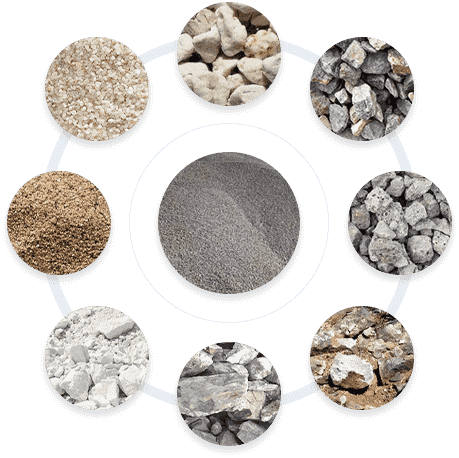
Aggregate is a granular material that serves as a skeleton and filler in concrete and mortar. When cement is mixed with water, it forms a thin paste. Without the addition of aggregate, it cannot be formed and cannot be used. Therefore, aggregate is a very important raw material in construction. Aggregates are divided into fine aggregates and coarse aggregates, with fine aggregates having a particle size of 0.16-5mm, mostly natural sand such as river sand and sea sand; Coarse aggregate with a particle size greater than 5mm, commonly including crushed stones and pebbles. Drying of aggregates can effectively reduce moisture content, ensure the stability of subsequent mixing processes and product quality, and is an indispensable step in aggregate processing technology.
A complete aggregate processing plant includes feeding, crushing, screening, drying, and sorting systems
Pre crushing of large pieces of gravel raw materials using hammering, and sorting of unsuitable debris to remove waste wood, plastic, and other debris for the next processing step. And conduct the initial magnetic separation to remove the waste iron material from the aggregate.
Firstly, the raw materials are first crushed using a jaw crusher, which is uniformly fed by a vibrating feeder. The jaw crusher uses jaw plate movement to crush large sand and gravel aggregates into smaller particle sizes. The coarse broken material is transported by the conveying equipment to the intermediate crushing area for further crushing. Finally, the conveyor belt transports the material to the sand shaping machine for fine crushing and shaping, and the sand and gravel aggregates processed by the sand shaping machine have uniform particle size.
Using a circular vibrating screen, divide the coarse crushed concrete aggregate into blocks of 0-40mm and crushed materials of 5mm or less. The coarse aggregate of 5-40mm collected can be directly used for the production of general C15-C20 concrete. Fine aggregates can be transported to intermediate piles for the next process.
Secondary crushing can be achieved using a ball mill to further grind fine aggregates. The secondary screening separates the crushed aggregate into high-quality recycled aggregates of 5-20mm, which can be used for the manufacturing of C25-C30 concrete. The tertiary screening separates high-quality recycled fine aggregates of 0.16mm-5mm and fine powders below 0.16mm.
Use a rotary dryer to reduce the moisture content of aggregates, and the target moisture content may vary depending on the usage scenario. For example, for ordinary commodity concrete aggregates, the moisture content requirement is 2-3%. For high-strength concrete/fine proportioned concrete, the moisture content requirement is 1-2%. For asphalt mixture aggregates, the moisture content requirement is 0.2-0.3%.
By using physical or physical-chemical methods to remove impurities and separate aggregates according to their properties, the purity, grade, and application value of finished aggregates are improved.
After completing crushing and screening, the moisture content of the aggregate is still high. If it is directly used for sorting, storage, or downstream applications, it will affect product quality and process stability. The aggregate drying system controls the water treatment of aggregates through a rotary dryer, which is a key link connecting "particle size grading" and "quality improvement". Its role is mainly reflected in the following aspects:

According to different application requirements, the moisture content of aggregates should be stably controlled within the target range to ensure accurate mix proportions and avoid affecting concrete strength or asphalt wrapping effect due to moisture fluctuations.
The flowability of the dried aggregate is better, which can effectively avoid the adhesion and agglomeration of wet materials, making the magnetic separation, air separation, light separation and other separation equipment work more stably and with higher separation accuracy.
Reducing moisture can reduce the risks of agglomeration, segregation, and secondary pollution during storage and transportation, and improve the consistency and commercial properties of finished aggregates.
The aggregate drying system consists of a conveying system, a control system, a drum, a hot air stove, a control system, and a dust removal system. The drum is equipped with blades, and the heat transfer efficiency is improved through mechanical stirring. After the wet aggregate enters the drying drum, it sequentially enters the following working areas: the first is the material guide area. After entering the area, the aggregate comes into contact with high-temperature hot air, and the moisture evaporates rapidly; The second is to enhance the board area. The aggregate is lifted and dropped in this area, and lifted to form a material curtain. At this point, the material comes into full contact with the hot air, and the moisture in the aggregate rapidly evaporates and converts into water vapor. The water vapor is immediately extracted by the induced draft fan to achieve the purpose of drying the aggregate. After heat exchange, the material reaches the required moisture content. The third is the discharge area. The drum in this area is not equipped with a lifting plate, and the material rolls to the discharge port in this area to complete the entire drying process.
Drying system for aggregate processing plant plays an important role in aggregate processing and is a key link in improving product quality. If you are interested in aggregate drying technology, please feel free to consult at any time.
Many mineral processing plants face a confusing problem: even with the same processing capacity, some copper concentrate drying lines consume far more fuel and power than others. The energy gap usually reaches 20%–40% in actual operation. The difference i
Utilizing boiler exhaust gas (120°C–180°C) from a power plant as the heat source for a fly ash dryer is a core strategy for reducing costs in fly ash recovery projects. However, three key issues must be addressed in practice:
Freshly washed sand retains too much surface moisture, unsuitable for direct storage, transportation or end-use processing. For sand production plants, professional sand drying equipment is essential to consistently reduce moisture and qualify finished sa
In the slag processing industry, traditional drying equipment often suffers from issues such as low thermal efficiency, rapid heat loss, and poor sealing, resulting in significant energy waste and high drying costs. In reality, the key to overcoming these